
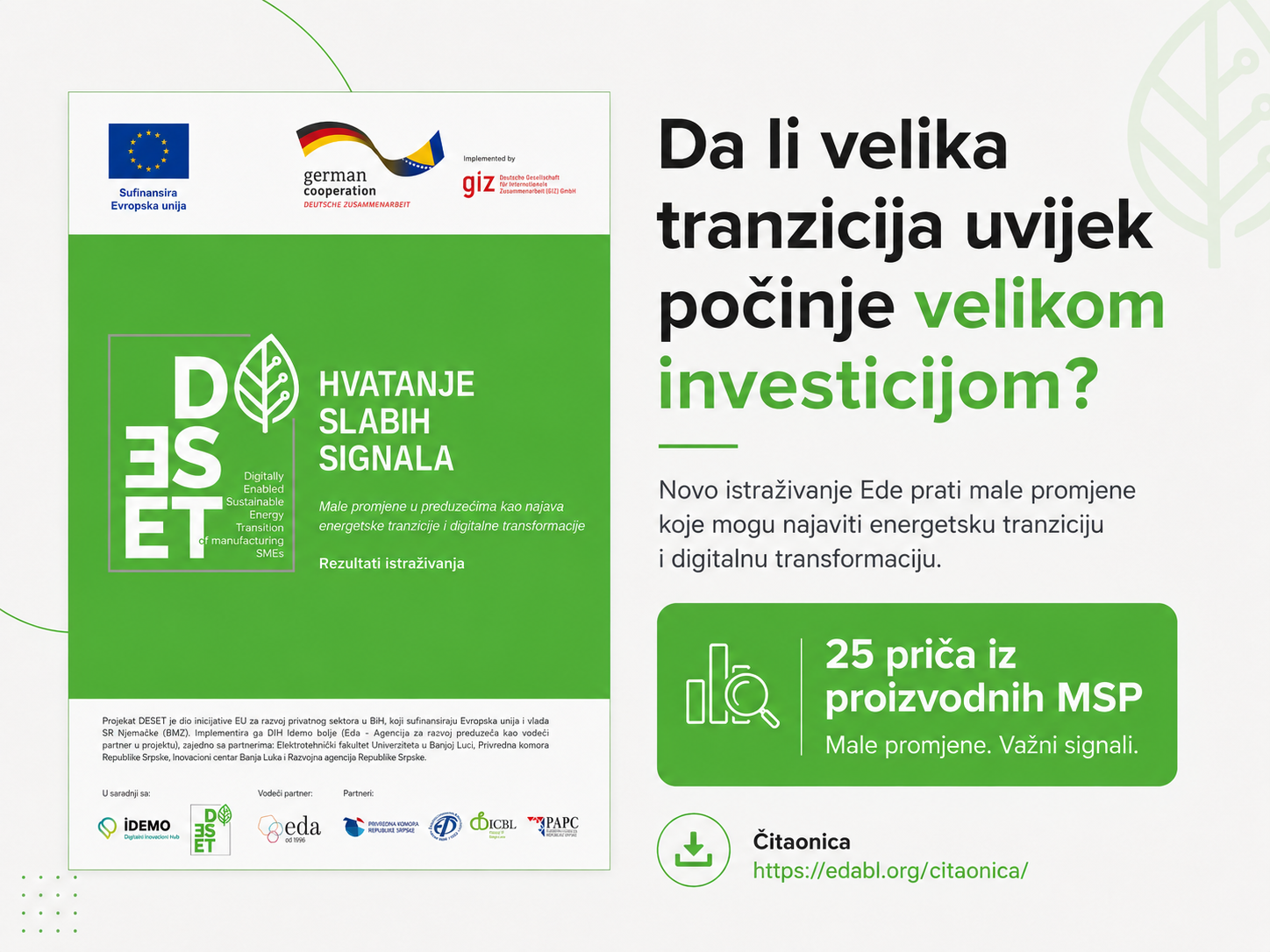
New publication “Capturing Weak Signals” draws on 25 real-life stories from manufacturing SMEs
Major transformations in companies do not always begin with a large investment, a formal strategy, or a complex project. Sometimes they start with a different work schedule, monitoring energy consumption, a new way of using equipment, or a simple digital tool.
These are precisely the kinds of changes explored in Eda’s new publication, “Capturing Weak Signals: Small Changes in Companies as Indicators of the Energy Transition and Digital Transformation,” authored by Pavle Miovčić and Goran Janković.
Rather than relying on a conventional survey, the study adopted a narrative research approach. Representatives of manufacturing companies shared 25 anonymous, real-life stories about changes that had already been introduced in small and medium-sized manufacturing enterprises. They then assessed the impact of these changes, their diffusion within the company, their sustainability, and their contribution to future development.
One of the most interesting findings is that change is often driven by more than just owners and managers. In many of the stories, the key drivers were process engineers, engineers, shift supervisors, and frontline employees—the people working directly in production who are the first to recognize opportunities to save energy, improve working conditions, or optimize production processes.
The research also shows that a good idea alone is not enough. Changes that become embedded in company procedures, rules, and everyday work routines prove to be significantly more sustainable than those that remain informal, ad hoc solutions. Fully formalized changes received an average sustainability score of 9.6 out of 10, compared with 6.9 for entirely informal changes.
Within the observed sample, energy-related technical interventions achieved stronger results than organizational, digital, and relationship-based changes. They were more visible, spread more widely throughout the organization, and proved more durable over time. At the same time, nearly all reported resistance was associated with digitalization and changes in work practices, rather than with energy equipment or technical upgrades.
Another important signal for future support programmes is companies’ willingness to continue their transformation. Of the 24 companies that provided a clear response to this question, 22 intend to take the next step. Twelve already know exactly what they want to do, while another ten plan to continue but have not yet developed a sufficiently detailed plan. These findings suggest that this is the right moment to provide expert, financial, and development support.
The publication also offers recommendations for the design of support programmes: help companies translate good practices into formal procedures; actively involve production staff in change processes; lower the barriers to engaging external experts; introduce digital solutions more carefully and strategically; and differentiate support between companies that already have investment plans and those that still need to define their next steps.
The findings should be interpreted as qualitative insights into emerging patterns rather than as a statistically representative picture of the economy as a whole. Their value lies precisely in the real-life stories that demonstrate what is already possible in domestic manufacturing companies.
Download the publication here: https://bit.ly/3TAVPiH
The research was conducted as part of the DESET (Digitally Enabled Sustainable Energy Transition of Manufacturing SMEs) project, implemented with the support of the European Union and the Government of the Federal Republic of Germany (BMZ) under the EU Initiative for Private Sector Development.
The DESET project is implemented by DIH IDEMO, a consortium comprising Eda – Enterprise Development Agency as the lead partner, the Faculty of Electrical Engineering, University of Banja Luka, the Chamber of Commerce of Republika Srpska, the Innovation Centre Banja Luka, and the Development Agency of Republika Srpska.